
Introduction
The global economy in 2026 is facing a major challenge as energy prices surge across international markets. Oil prices have risen sharply, supply chains are under pressure, and governments are struggling to control inflation. What initially appeared to be a regional issue has now turned into a full-scale global energy crisis.
From rising fuel costs to increasing electricity bills, the effects are being felt by individuals, businesses, and governments alike. This article takes a deep dive into the causes behind the crisis, its widespread economic impact, and what the future may hold for the global energy sector.
🔥 What Is Causing the Global Energy Crisis in 2026?
1. Geopolitical Conflicts in Key Oil Regions
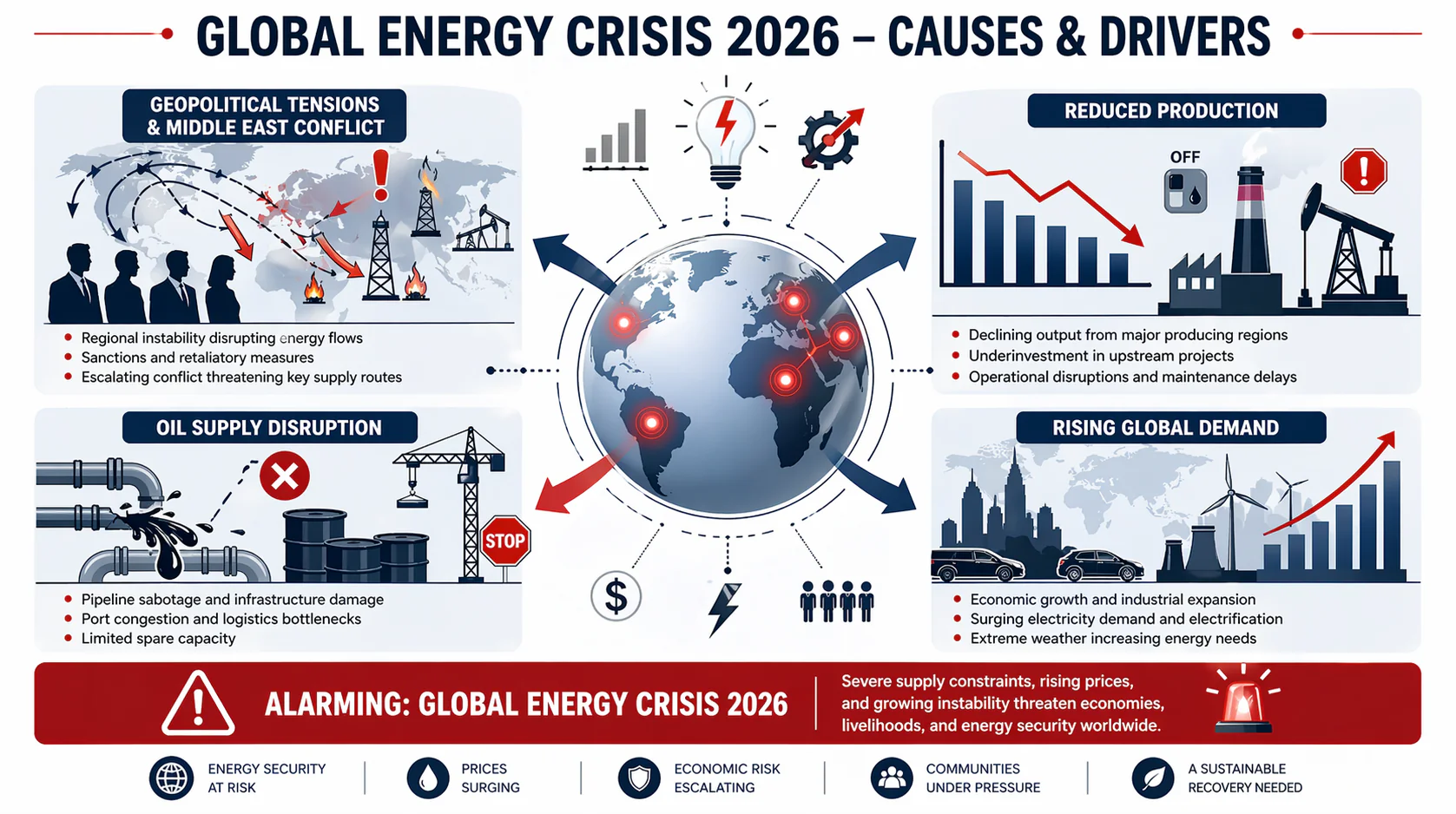
One of the primary reasons behind the energy crisis is geopolitical tension in oil-producing regions. Conflicts and instability in the Middle East have disrupted oil production and transportation.
Critical oil routes are facing uncertainty, and even small disruptions can create a ripple effect across global markets. When supply becomes uncertain, prices naturally increase due to fear and speculation.
2. Supply Chain Disruptions
Even outside conflict zones, global supply chains are struggling. Shipping delays, increased transportation costs, and logistical challenges have made it difficult to maintain a steady flow of oil.
These disruptions reduce supply availability in international markets, which directly contributes to rising prices.
3. Changes in Oil Production Policies
Oil-producing nations play a major role in determining global supply. When production levels are reduced or controlled, prices tend to rise.
Recent policy shifts by major producers have tightened supply, leading to increased competition among importing countries.
4. Rising Global Demand
As economies continue to recover and grow, the demand for energy is increasing rapidly. Developing countries, in particular, are consuming more fuel to support industrial growth and urbanization.
When demand rises faster than supply, it creates an imbalance that pushes prices higher.
📈 Impact of Rising Energy Prices
1. Inflation and Economic Pressure
Higher energy prices have a direct impact on inflation. When fuel costs increase, transportation and manufacturing become more expensive.
Businesses pass these additional costs on to consumers, leading to higher prices for everyday goods and services.
2. Cost of Living Crisis
For individuals, the energy crisis means higher petrol prices, expensive electricity, and increased food costs.
Basic necessities are becoming more expensive, putting pressure on household budgets—especially in low- and middle-income regions.
3. Impact on Businesses
Businesses across industries are facing rising operational costs. Sectors such as transportation, logistics, and manufacturing are the most affected.
Small and medium-sized businesses are particularly vulnerable, as they have limited resources to absorb these additional costs.
4. Challenges for Developing Countries
Developing countries are experiencing the most severe effects of the crisis. Many of these nations rely heavily on imported fuel.
As prices rise, governments face difficult decisions—either increase fuel prices or provide subsidies, which can strain national budgets.
🌐 Global Economic Consequences
Slower Economic Growth
The energy crisis is expected to slow global economic growth. Higher costs reduce consumer spending and limit business expansion opportunities.
Market Instability
Financial markets are reacting to uncertainty in oil prices. Investors are becoming cautious, leading to increased volatility in global markets.
Trade Imbalances
Oil-importing countries are facing higher import bills, while exporting countries are benefiting from increased revenues.
This imbalance is reshaping global trade relationships and economic power dynamics.
⚡ Government Responses to the Crisis
1. Use of Strategic Oil Reserves
Many governments are releasing oil from their emergency reserves to stabilize supply and control prices.
2. Fuel Subsidies
Some countries are providing subsidies to reduce the burden on consumers. While this helps in the short term, it is not a sustainable long-term solution.
3. Investment in Renewable Energy
The crisis has accelerated global investment in renewable energy sources such as solar and wind power.
Countries are now focusing on reducing their dependence on fossil fuels.
4. Diplomatic Efforts
International cooperation is increasing, with governments working together to stabilize markets and reduce geopolitical tensions.
🌱 The Shift Toward Renewable Energy
The current crisis has made it clear that reliance on fossil fuels comes with risks. As a result, countries are now prioritizing renewable energy solutions.
Advantages of Renewable Energy
- Reduces dependence on imported oil
- More environmentally sustainable
- Provides long-term price stability
Challenges of Transition
- High initial costs
- Infrastructure development required
- Time needed for large-scale adoption
Despite these challenges, the transition to clean energy is gaining momentum.
🔮 Future Outlook of the Energy Market
Short-Term Outlook
- Oil prices are likely to remain volatile
- Inflation may continue to rise
- Supply chain issues may persist
Long-Term Outlook
- Increased adoption of renewable energy
- Reduced reliance on fossil fuels
- Technological advancements in energy storage
Experts believe that while the crisis is challenging, it may lead to a more sustainable energy future.
🧠 What Individuals Can Do
Practical Steps to Manage Energy Costs
- Reduce unnecessary fuel consumption
- Use energy-efficient appliances
- Switch to alternative transportation where possible
- Monitor and manage household budgets
Small lifestyle changes can help reduce the impact of rising energy costs.
🏁 Conclusion
The global energy crisis of 2026 is a complex issue driven by geopolitical tensions, supply disruptions, and increasing demand. Its effects are widespread, influencing economies, businesses, and individuals worldwide.
While the situation presents serious challenges, it also creates an opportunity for transformation. The shift toward renewable energy and sustainable practices could shape a more stable and secure energy future.
❓ FAQ Section
1. What is causing the global energy crisis in 2026?
The crisis is mainly caused by geopolitical conflicts, supply chain disruptions, controlled oil production, and rising global demand.
2. How does the energy crisis affect everyday life?
It leads to higher fuel prices, increased electricity bills, and rising costs of goods and services.
3. Which countries are most affected?
Developing countries that rely on imported oil are the most affected.
4. What are governments doing to fix the crisis?
Governments are using oil reserves, subsidies, and investing in renewable energy to stabilize the situation.
5. Is renewable energy the future?
Yes, renewable energy is considered the most sustainable long-term solution to avoid future crises.
6. Will oil prices decrease soon?
Prices may remain unstable in the short term but could stabilize in the long term with improved supply and alternative energy adoption.
