
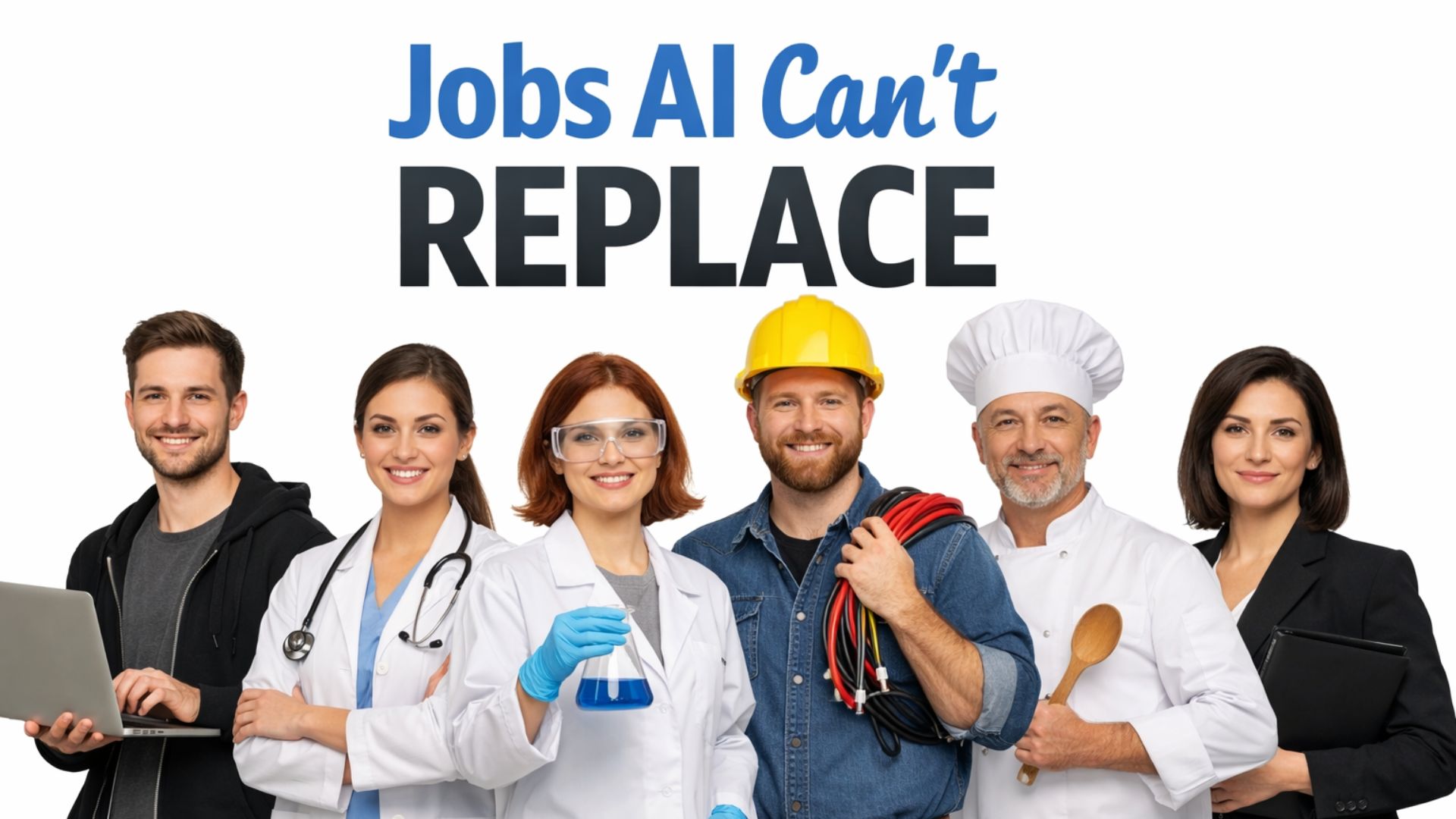
Every few months, a fresh headline predicts that artificial intelligence will devour millions of Indian jobs. And yes, automation is reshaping the workforce — chatbots are handling customer queries, algorithms are reading medical scans, and code-generation tools are writing entire software modules in seconds. But here is what those headlines routinely miss: AI is extraordinarily good at pattern recognition, and extraordinarily bad at being human.
India’s labour market is vast, diverse, and deeply relational. Many of the country’s most resilient careers are built on precisely the qualities machines cannot replicate — empathy, cultural nuance, physical dexterity in unpredictable environments, moral judgment, and creative originality. Below is a grounded, research-backed look at the jobs that will remain stubbornly human for the foreseeable future.
1. Teachers and Educators (Especially at School Level)
An EdTech platform can deliver content, but it cannot notice that a twelve-year-old in the back row has been unusually quiet for two weeks. It cannot adjust its tone when a rural child is too intimidated to ask a question, or celebrate a small win in a way that changes how that child sees herself.
India has over 250 million school-going children and a chronic teacher shortage. The role demands emotional attunement, mentorship, and community trust — none of which can be automated. AI will assist teachers through personalised content and admin relief, but it will not replace the person standing in front of the classroom.
2. Healthcare Professionals — Doctors, Nurses, and Surgeons
AI can read a chest X-ray faster than a radiologist. What it cannot do is sit across from a frightened patient’s family and explain, with compassion and cultural sensitivity, what comes next.
India’s healthcare system is already understaffed by global standards. Nurses and frontline health workers perform physically demanding, emotionally intensive labour in wildly variable conditions. Surgeons must make split-second judgment calls when anatomy doesn’t cooperate with the textbook.
3. Skilled Tradespeople — Electricians, Plumbers, and Mechanics
Robotics researchers have a saying: it is easier to build a machine that beats a chess grandmaster than one that can replace a plumber fixing a leaking pipe under a 1980s Mumbai apartment.
The “Moravec Paradox” — the counterintuitive idea that high-level reasoning is easy for machines while low-level sensorimotor skills are hard — is playing out in India’s job market in real time. Electricians, plumbers, carpenters, welders, and AC technicians operate in chaotic, non-standardised physical environments. .
4. Social Workers and Community Development Professionals
India’s NGO and social development sector employs hundreds of thousands of people whose work is almost entirely relational. Whether they are working with survivors of domestic violence, rehabilitating children in conflict with the law, or facilitating self-help groups in tribal districts, their effectiveness depends on trust built over time with specific communities.
5. Lawyers and Judges (Core Judicial Functions)
Legal AI tools can research case law, draft contracts, and summarise documents at impressive speed. But the adversarial process — courtroom advocacy, cross-examination, weighing contradictory testimonies, and the discretionary exercise of judicial wisdom — is fundamentally human.
6. Performing Artists, Musicians, and Craftspeople
Generative AI can produce a passable Bollywood track or a piece of digital art. But the market for authentically human creativity — a live classical vocalist, a Warli painter, a Kathak dancer — is not shrinking. If anything, it is growing, because audiences value the human story behind the work as much as the work itself.
India’s rich tradition of folk art, classical music, regional cinema, and handloom craft represents not just cultural heritage but a significant economic sector. The craft of a Banarasi weaver or a Kondapalli toy maker is deeply personal, place-based, and irreducibly human.
7. Mental Health Professionals
India has approximately 0.3 psychiatrists per 100,000 people — one of the lowest ratios in the world — while the burden of mental illness is rising sharply. Chatbots like Woebot offer some psychoeducation, but they are no substitute for a trained therapist navigating trauma, suicidality, family conflict, or psychosis.
8. Entrepreneurs and Business Leaders
AI can optimise. It cannot originate. Starting a business in India’s complex regulatory and social environment requires negotiation, relationship-building, risk appetite, and the ability to pivot when conditions change in ways no model predicted.
The entrepreneurs who will thrive are those who use AI as a productivity multiplier while supplying the vision, the hustle, and the people skills that no algorithm can generate.
9. Agricultural Specialists and Sustainable Farming Advisors
While precision agriculture tools are growing, India’s farm sector is dominated by smallholder farmers operating in highly localised, variable conditions. Agricultural extension workers who speak the local language, understand local soil and crop varieties, and have earned a community’s trust are essential intermediaries that technology cannot replace.
10. Spiritual and Religious Leaders
India’s enormous and diverse religious ecosystem — with its millions of temples, mosques, churches, gurudwaras, and informal spiritual communities — is sustained by human beings who provide meaning, ritual, community, and comfort. This is perhaps the most deeply human function of all, and it is entirely beyond the reach of any machine.
The Bigger Picture
The jobs most at risk from AI in India are those involving routine cognitive tasks — data entry, basic accounting, template-based legal drafting, and certain categories of customer service. The jobs that endure share three properties: they require embodied physical skill in non-standardised environments, genuine emotional intelligence, or creative and moral judgment.
India’s workforce of 500 million-plus people is not a monolith. Automation will hit urban, white-collar, routine-task jobs harder than it hits trades, care work, education, and the arts.
Top Google Searches Related to This Topic
- What jobs will AI not replace in India 2025
- Jobs safe from AI in India
- Future-proof careers in India
- Which profession is most secure from automation in India
- Will doctors be replaced by AI in India
- Are teachers safe from AI in India
- AI impact on Indian employment
- Highest demand jobs in India future
- Skills that AI cannot replace
- Best career options in India after AI revolution
FAQ: What Jobs Will AI Not Replace in India?
Q1. Will AI replace software engineers in India? Partially, over time. AI coding assistants are already automating repetitive development tasks. However, senior engineers who architect systems, manage teams, engage with clients, and make high-stakes technical decisions remain essential. The demand for skilled engineers who can work with AI tools is actually rising.
Q2. Is teaching a safe profession from AI in India? Yes, especially school-level teaching. The relational, mentoring, and community dimensions of teaching are very difficult to automate. AI tools will assist teachers, not replace them. India’s massive student-to-teacher ratio also means demand will stay high for decades.
Q3. Which blue-collar jobs are safest from AI in India? Electricians, plumbers, welders, mechanics, carpenters, and construction workers operate in unpredictable physical environments that are extremely difficult to automate. These trades are actually facing a labour shortage and will remain in high demand.
Q4. Can AI replace doctors in India? AI can assist with diagnosis (especially in radiology and pathology), but it cannot replace the clinical judgment, patient communication, and ethical decision-making of a practicing doctor. India’s significant doctor-to-patient deficit makes this even less likely in the near term.
Q5. What skills should Indian students develop to be AI-proof? Focus on: emotional intelligence and interpersonal skills, creative and critical thinking, physical trades and craftsmanship, entrepreneurship, complex problem-solving, and domain expertise combined with AI literacy. Learning how to use AI tools effectively is itself a major career advantage.
