
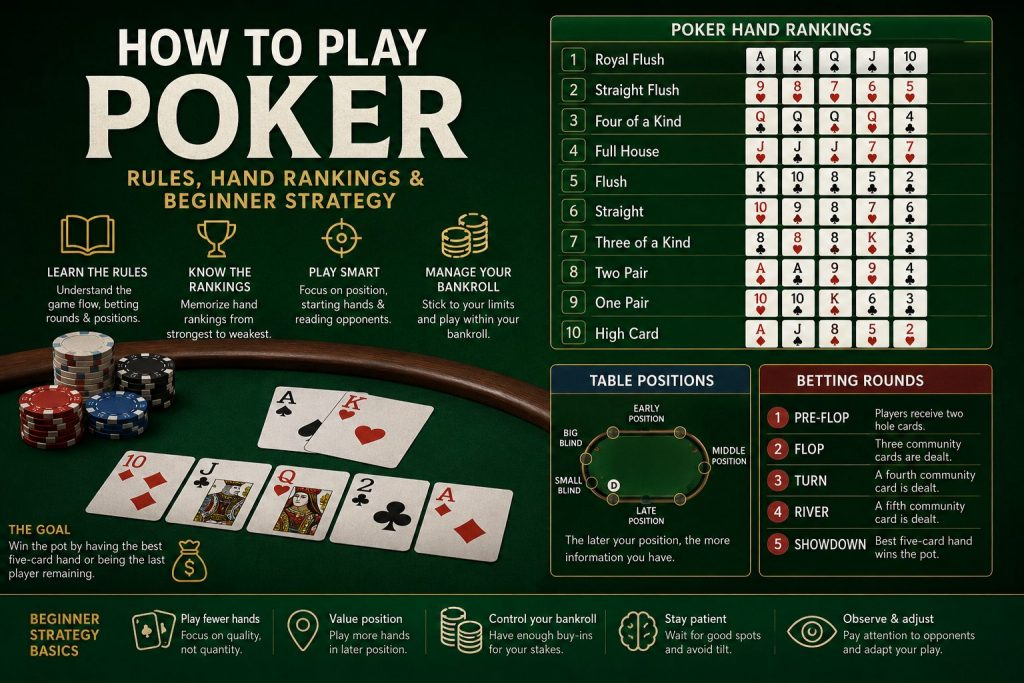
Anyone browsing digital card games through references such as nhà cái iwin should distinguish poker from games where a fixed result is settled against a house.
Poker is a family of card games in which players may compete with one another, combining known cards, hidden information and decisions about continuing in a hand. Rules depend on the variant, but common themes include hand ranking, betting order and the difference between the cards one holds and the range another participant might hold.
There is a difference between knowing the vocabulary and understanding how a feature works in practice. Small choices in presentation can change the way information is interpreted, even when the underlying rules remain unchanged. The following guide connects the terminology with concrete examples, common misunderstandings, and sensible checks.
Poker Begins With a Variant
In Texas Hold’em, each player usually has two private cards and shares five community cards, while other poker variants distribute information differently. The practical implications emerge when the label is translated into a real sequence of actions. A description of five-card draw cannot be used unchanged to explain Hold’em because the sequence and availability of shared cards are different. Understanding texas hold’em is only one example requires more than recognising the label. Translating the wording into a specific action, rule or calculation removes an important source of ambiguity.
Texas Hold’em is only one example. Identify the exact variant before applying advice about hand rankings, betting order or the number of cards used at showdown. Test the interpretation against a simple hypothetical example. If the wording supports two incompatible readings, seek a more precise definition before relying on it. Even closely related variants can differ in who acts first and which combinations are legal. Treat the explanation as a checklist, not a prediction. Conditions can change, while transparent documentation remains more useful than unsupported certainty.
The Five-Card Hand Hierarchy
In standard high poker, hands are ordered from high card through pairs, straights, flushes and the strongest combinations, subject to tie-break rules. A small example shows why the distinction deserves attention. A pair of queens generally beats a pair of tens, but the remaining cards can matter when two players hold pairs of the same rank. When examining ranked combinations form the language, the useful distinction is between a surface impression and the details a reader can actually verify. Clear terms make that comparison more dependable.
Ranked combinations form the language. Learn the hierarchy with a set of printed examples and check how the best five-card hand is selected in the chosen variant. Compare the main display, help material and formal rules for consistency. Contradictory wording deserves attention because even a small omission can change expectations. A seven-card situation can contain several possible five-card subsets, only one of which will be the highest-ranking hand. The goal here is clarity rather than certainty. A short account cannot replace current terms or transform one example into a guaranteed result.
Before Your First Practice Hand
- Start with the exact poker variant and the cards dealt.
- Memorise the standard hand hierarchy and tie-break method.
- Understand position and action order before judging decisions.
- Treat probability estimates as uncertain information, not predictions.
Position Changes the Information Available
Acting later in a betting round usually allows a player to observe more of the preceding actions before making a decision. One useful way to frame the issue is through an ordinary reader encountering the feature for the first time. Someone in an early seat may have to choose without seeing how several other players respond, while a later seat can use those additional observations. For action order has consequences, an accurate comparison relies on the conditions governing the action. A bold slogan or highlighted number alone cannot answer what actually produces a result.
Action order has consequences
Review the dealer button, blinds or antes, and the round-by-round action order rather than discussing starting cards in isolation. Think about both the usual case and an unusual outcome when reviewing action order has consequences. Edge cases often reveal gaps that a straightforward example leaves hidden. Observed actions are evidence of behaviour, not certain knowledge of an opponent’s hidden cards. When financial choices are involved, understanding the process can inform decisions but never eliminate uncertainty or possible losses.
Reading a Betting Round
Poker decisions are not interchangeable: the available actions depend on whether a bet is outstanding and on the specific game’s betting structure. The difference becomes easier to appreciate in a concrete situation. A player may be permitted to check when no bet is faced but may need to call, raise or fold when another participant has wagered. With call, raise, check and fold have rules, a quick browse may leave the crucial distinction unclear. Establishing what is included and excluded is more useful than accepting a simplified promotional description.
Call, raise, check and fold have rules
Read the definitions of minimum raises, all-in action and the conditions under which a betting round ends. While assessing call, raise, check and fold have rules, separate what is documented from what remains uncertain. This prevents one appealing example from being repeated as a general rule without evidence. Different table-limit structures can change what a legal raise means. That is why a claim about call, raise, check and fold have rules should identify the version and assumptions involved. An observation from one setting need not hold in another.
Probability Does Not Guarantee a Hand
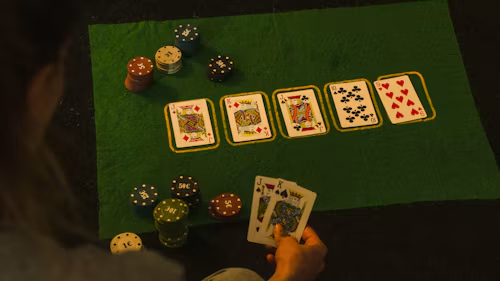
Known cards can sometimes support a calculation of remaining possible improvements, but probabilities should be tied to an exact situation. Consider how the same feature might be interpreted by someone who sees only a short description. A person holding four cards toward a flush may calculate available unseen suit cards but still fail to complete the hand. In the context of odds are information, not certainty, appearance cannot replace a clear explanation of the rules. Naming the relevant variables makes it easier to distinguish substance from presentation.
Odds are information, not certainty. Distinguish the chance of improvement from the broader question of whether an eventual hand will be the best one. For odds are information, not certainty, read the relevant terms before drawing conclusions. A lone graphic or isolated figure leaves important conditions unspecified; those missing details should not be filled in by guesswork. A correct mathematical estimate does not reveal hidden opponent cards or guarantee a positive decision outcome. In practice, odds are information, not certainty may be treated differently by different variants, regions or implementations. The published instructions for the specific version therefore remain essential.
Core Poker Actions
| Action | Typical meaning |
| Check | Continue without betting when permitted. |
| Call | Match the currently required amount. |
| Raise | Increase the required commitment under table rules. |
| Fold | End participation in the current hand. |
Poker Etiquette and Responsible Play
Good habits include following turn order, making actions unambiguous, respecting opponents and understanding the table’s dispute rules. The practical implications emerge when the label is translated into a real sequence of actions. An accidental action or unclear chip movement can create confusion even when a participant knows the hand rankings well. Understanding clarity matters beyond the cards requires more than recognising the label. Translating the wording into a specific action, rule or calculation removes an important source of ambiguity.
Clarity matters beyond the cards. If participating financially where lawful, establish limits and avoid treating poker skills as a substitute for financial security. Test the interpretation against a simple hypothetical example. If the wording supports two incompatible readings, seek a more precise definition before relying on it. Even experienced players can lose, and legality and age rules must be checked independently. Treat the explanation as a checklist, not a prediction. Conditions can change, while transparent documentation remains more useful than unsupported certainty.
The Fundamentals That Carry Over
Poker becomes more understandable when the fundamentals are learned in a deliberate order: variant, hand ranking, turn sequence, actions and uncertainty. That framework supports clearer decisions and avoids reducing a complex social card game to a collection of simplistic tips.
An introduction to Bài Poker is strongest when it explains those principles and explicitly identifies the poker version being discussed.
